The Tool, Not the Theft: Where I Stand in Music's AI Civil War
There's a record store in Portland that canceled a CD release party three days before it happened. Not because of a scheduling conflict. Because the album was made with AI, and once that got out, the backlash showed up faster than the show could. The artist had been playing that store since 2013. None of that mattered once people decided what he'd made wasn't real.
I read that story and felt two things at once, which is the most honest place I can start this from. Part of me understood the anger completely. Part of me sat there as JOVX — a producer who leans on AI for the one thing I can't do myself — and thought: that could be me.
So let's talk about it directly, because the music industry isn't having a nuanced conversation about AI right now. It's having a war. And I think the war is being fought over the wrong question.
The fight that's actually happening
Music and AI have been at odds for a while now, but 2026 is the year it stopped being a background tension and became the main event. A Luminate report on generative AI in entertainment found something that should worry anyone betting on AI music's inevitability: listener sentiment toward AI music has been moving from positive to negative, and across the board, consumers are net negative on it — more people feel uncomfortable with AI in music than comfortable. That's not a fringe reaction. That's the center of the audience.
iHeartMedia felt that shift enough to put it in writing. Chief Programming Officer Tom Poleman sent a memo pledging the company wouldn't play AI music featuring synthetic vocalists pretending to be human, citing internal research that 96% of consumers find "Guaranteed Human" content appealing. Meanwhile a Deezer-commissioned Ipsos survey found 97% of people couldn't actually tell whether a song was AI-generated or human-made — which means the demand for "guaranteed human" isn't really about what people can detect. It's about what they want to trust.
And the numbers on the supply side are getting strange. Deezer reported that roughly 44% of daily uploads to its platform are now AI-generated — but those tracks account for less than 3% of total streams, and most of those streams are flagged as fraudulent, likely bot-driven rather than real listening. So there's a flood of AI content and almost nobody actually listening to most of it. That's not a wave breaking over the industry. That's noise drowning out signal — which, if you've ever mixed a track, you know is the worst kind of problem to have.
On the legal side, it's just as messy. Warner Music Group settled with AI music company Suno last November, and rival Udio struck deals with Warner and Universal — but Suno is still locked in conflict with Universal and Sony, and Google's Lyria 3 is now facing its own lawsuit from independent musicians. More than a thousand musicians, McCartney among them, backed a protest album aimed squarely at AI music that doesn't compensate the humans whose work trained it. The industry hasn't settled this. It's mid-fight, and the casualties are landing on independent artists first — the ones with the least leverage and the most to lose from a flood of unlabeled synthetic content competing for the same limited royalty pool.
I'm not writing this to referee that fight from the outside. I'm writing it because I'm standing inside it, making music with the tools everyone's arguing about, and I think the argument itself has a flaw in its foundation.
The binary is the problem
Pro-AI. Anti-AI. Pick a side. That's the frame the discourse keeps handing us, and it's a bad frame, because it treats "AI in music" as one thing when it's at least two completely different things wearing the same name.
There's AI that replaces the creative act — type a prompt, get a finished song, no instrument touched, no lyric wrestled with, no take re-recorded at 1 a.m. because the first nine weren't right. And there's AI that fills a gap in a process a human is still driving — still writing, still arranging, still deciding what the track needs and what it doesn't.
A researcher who's been tracking what musicians actually want from these tools put it plainly: most musicians aren't asking AI to replace the core creative job — they want AI that saves time, improves feedback, respects consent, and leaves the human clearly in charge of the musical point of view. That's not a hedge. That's the real demand signal underneath all the noise, and it's the demand signal I fall into.
I don't think "AI music" is one category that you're either for or against. I think there's a line running straight through the middle of it, and almost nobody's naming the line. So I'll name mine.
My case, specifically
I produce under JOVX. I write the songs. I build the arrangements, choose the textures, decide what a track needs to breathe and what it needs to cut. What I cannot do — what I have never been able to do, no matter how many hours I've put into trying — is sing.
That's not false modesty. That's just true, the same way it's true that I can spec a fiber run for a broadcast facility but I can't lay the actual glass myself. I know what the song needs to sound like. I don't have the voice to deliver it. So I use AI to provide vocals for songs I wrote, on a creative vision I built, because the alternative isn't "do it myself" — the alternative is the song never exists.
The same logic runs through some of the instrumentation. There are textures and instruments that would cost more than the track will ever earn back — real strings, certain analog synths, full live percussion sessions. I don't have unlimited studio budget. Most independent producers don't. So sometimes I lean on AI to generate a loop or a sound I can't access any other way, the same way a producer twenty years ago leaned on a sampler instead of flying in an orchestra.
That's not new, by the way. It's not even a new argument. When the Fairlight CMI showed up with the ability to sample and play back real instruments, the Musicians' Union called it a "lethal threat" to their members. Decades later, researcher Christopher White notes that conservatory music students today are among the most AI-skeptical people you'll meet — the fear runs in cycles, and the technology that gets called a threat in one decade sometimes becomes a textbook instrument in the next. I'm not claiming AI vocals are headed for that exact same arc. I'm saying the shape of this fight — new tool, old fear, real stakes on both sides — isn't unprecedented, and that should make all of us slower to declare a final verdict.
The line that actually matters: disclosure
Here's where I think the anti-AI argument gets something genuinely right, and I want to sit with that instead of rushing past it.
Ron Gubitz, who runs the Music Artists Coalition, said something that I think is the most honest sentence in this entire debate: "We're not anti-AI. We just want to make sure that this is done fairly." Fair means knowing how your work was used. Fair means being able to withhold consent. Fair means getting paid. None of that is an unreasonable ask, and none of it is satisfied by a wave of unlabeled AI tracks competing for the same streaming royalty pool that real musicians — the ones paying for studio time, the ones with mortgages and tuition loans riding on this — depend on to survive.
That's exactly why I don't put AI vocals on a JOVX track and let people assume they're hearing me sing. I'm not interested in passing. Every release where I use AI-generated vocals, I'm upfront about it — because the dishonesty isn't in using the tool. The dishonesty is in hiding that you used it and letting the listener extend trust they wouldn't extend if they knew.
That's the actual fault line, as far as I'm concerned. Not "did a human do every part of this." Whether the human is still honest about which parts are which.
Tool-assist AI vs. full-generation AI
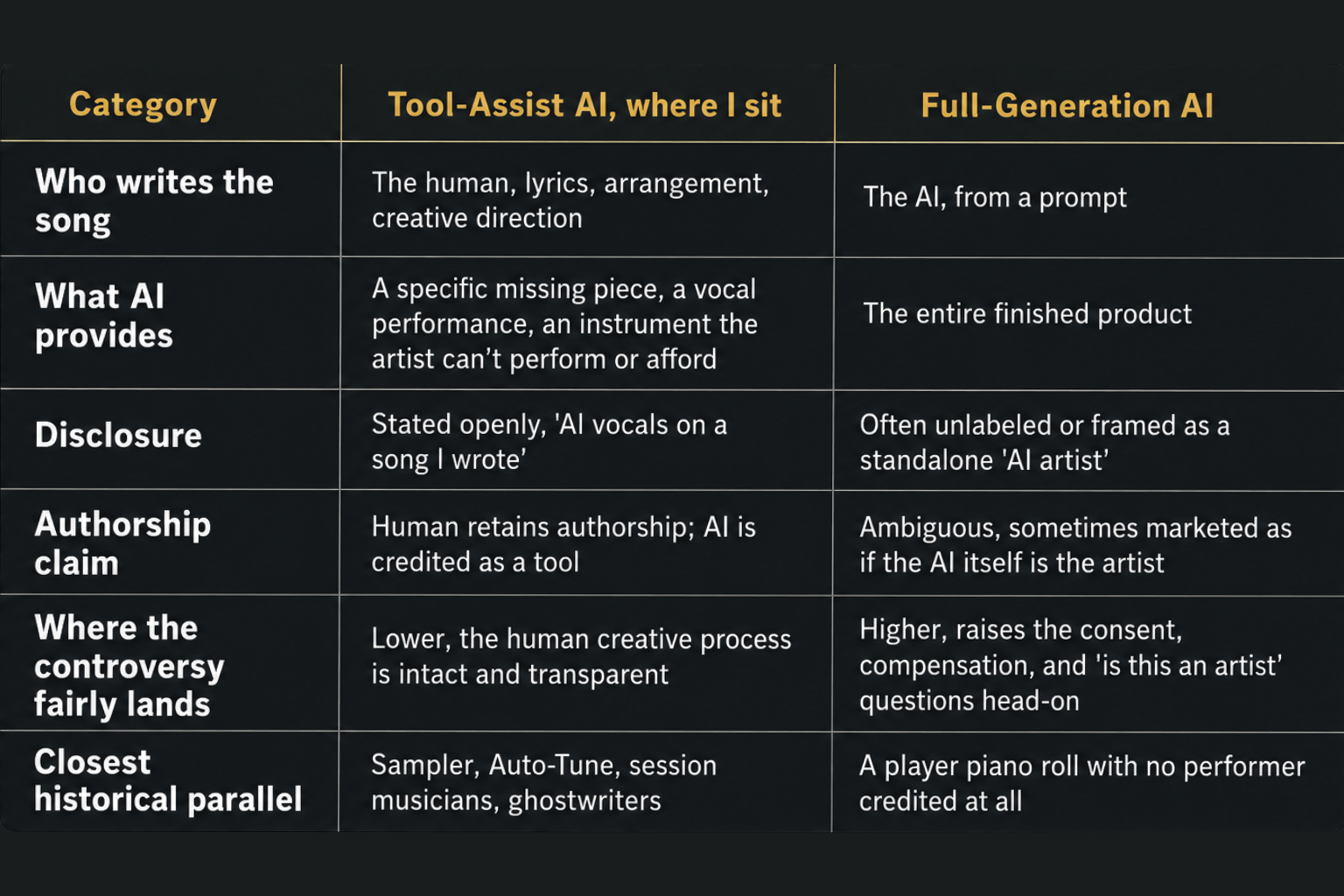
That table isn't a defense of every use of AI in music. It's a map of where the real disagreement lives — and most of the loudest fights right now are actually fights about the right column, even when they get aimed at everyone standing anywhere on the chart.
Where I think the anti-AI side is right to be worried
I want to steelman this properly, because I think the concern is legitimate even where I land differently.
If full-generation AI tracks keep flooding the platforms — even at the fraction-of-a-percent listening share Deezer is currently reporting — the pro-rata royalty math still gets diluted for everyone else. A flood doesn't need to be popular to be costly. It just needs to exist in volume. And if labels keep signing licensing deals with AI companies while individual working musicians get none of that upside, the imbalance Gubitz is describing gets worse, not better, regardless of how good any single AI vocal sounds.
I also don't think every use case is as clean as mine. A song that's 100% prompted — no human lyric, no human arrangement decision, marketed as if the AI itself has a creative point of view — is a different animal than what I'm doing, and I understand why the industry wants a different chart for it, the way one TIME columnist argued AI releases shouldn't even be called "artists" but products, kept separate from human musicians who have real financial lives riding on this work. I don't fully agree with quarantining the whole category — I think that erases the tool-assist middle ground entirely — but I understand the instinct, and it's coming from a real place, not just nostalgia for how things used to work.
The Grounded Fidelity position
I don't think the future of music is "AI" or "no AI." I think it's whose hands stay on the wheel — and whether the person driving is honest about who's in the car with them.
I can't sing. I can produce, write, arrange, and hear a finished track in my head before a single sound exists. AI closes the gap between what I can hear and what I can physically deliver, the same way a sampler closed a gap forty years ago and a session vocalist closes a gap for someone else today. The difference between that and what's drawing the real backlash isn't the technology. It's whether the human stays accountable for the work, names the tool out loud, and never lets the machine wear the artist's name.
That's the position I'm standing on with JOVX. Not pro-AI. Not anti-AI. Pro-honesty about which parts are mine and which parts I borrowed the capability to finish.
If you want to hear where that line actually lands in a finished track — not just argued about, but produced — "Still Breathing" is out under JOVX wherever you stream. And if you want more of this conversation as it develops, on both sides of the boards I work — broadcast infrastructure and the studio — The Private Frequency is where I write the parts that don't fit in a single post.
Sources
Schomer, Audrey, via Marin, Elena. "AI music is flooding streaming platforms. But listeners like it less and less." NPR, May 2, 2026. https://www.npr.org/2026/05/02/nx-s1-5804489/music-listeners-dislike-ai-music-study
"It's Time to Rage Against the AI Music Machine." TIME, March 11, 2026. https://time.com/7338205/rage-against-ai-generated-music/
"AI music is reviving the same fights that shaped the player piano." Scientific American, April 21, 2026. https://www.scientificamerican.com/article/ai-music-is-reviving-the-same-fights-that-shaped-the-player-piano/
"What Musicians Actually Want from AI in 2026." Practis Blog, March 16, 2026. https://pract.is/blog/what-musicians-actually-want-from-ai-in-2026