Jack Douglas
Remembering Jack Douglas: What the Textbook Can’t Teach You
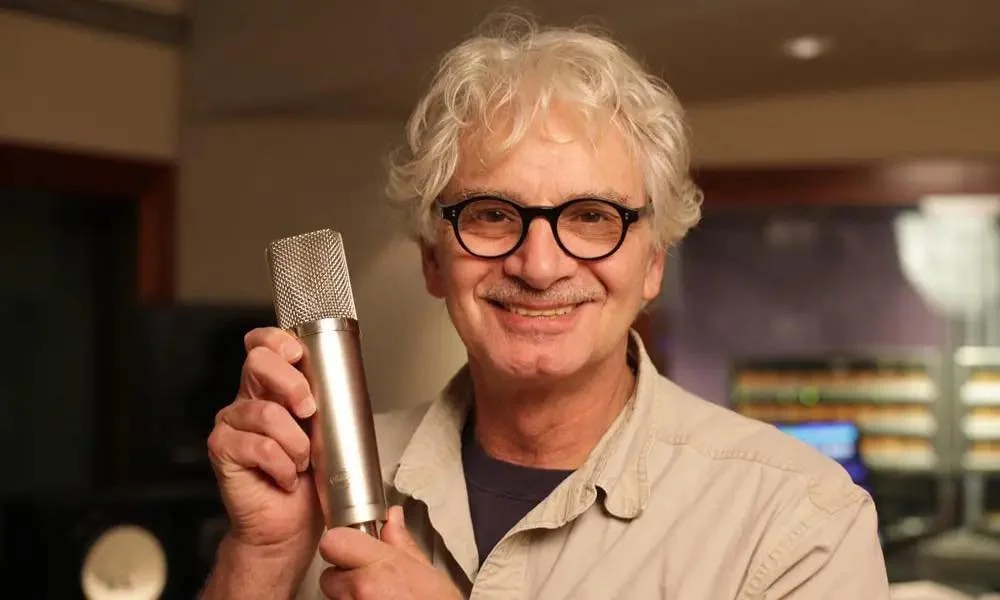
The Man Behind the Music: Remembering Jack Douglas
There are people who work in the music industry, and then there are people who are the music industry. Jack Douglas was the latter. He was a man whose fingerprints are on some of the most important recordings in the history of rock and roll, and whose voice, if you were lucky enough to hear it in a classroom, changed the way you thought about sound forever.
Jack passed away Monday, May 12th, 2026, and the world lost one of its great ones. The industry will feel it. So will every student who ever sat across from him and had their entire understanding of production quietly dismantled and rebuilt from the ground up.
From the Bronx to the Board
Jack Douglas's story doesn't begin in a recording studio. It begins with a teenager from the Bronx who loved the Beatles so much that he stowed away on a freighter headed to England, no passport, just a black Les Paul guitar, and got himself deported, making the front page of the local paper on his way out.
John Lennon, years later, would tell him with wide-eyed delight: "You were that crazy American."
That story says everything you need to know about Jack Douglas. He moved toward what he loved with complete disregard for the conventional path. And that instinct, that willingness to throw himself headfirst at the thing that mattered, is what made him extraordinary; Both behind the glass and in front of a classroom.
After training at the Institute of Audio Research as a member of its very first graduating class, Jack landed his first job at the then-new Record Plant in New York City. Not as an engineer. Not as an assistant. As the janitor. He mopped floors, watched everything, and took notes the entire time. He was also, simultaneously, composing scores for ABC Afterschool Special television programs. The janitor was writing for network TV. That was Jack.
He worked his way up the ranks: Dubber, Tape Librarian, Editor, Engineer, until a chance cigarette break in an editing room changed his life.
John Lennon wandered in looking for somewhere to hide, heard the story about the crazy American on the Liverpool front page, and said, essentially: you should be working on my album.
Jack Douglas went from janitor to engineering Imagine in the span of a few years. The rest, as they say, was history.
The Records That Shaped Rock and Roll
Jack Douglas didn't just work on great albums. He helped create the template for what great albums could be.
His run with Aerosmith across the 1970s stands as one of the most productive producer-artist partnerships in rock history. Get Your Wings (1974), Toys in the Attic (1975), Rocks (1976), and Draw the Line (1977) — four albums, all multi-platinum, two of them ranked among Rolling Stone's 500 Greatest Albums of All Time. "Walk This Way." "Sweet Emotion." "Back in the Saddle." "Last Child." These weren't just hits. They were sonic benchmarks that defined a decade and went on to influence genres from rock to hip-hop. When Run-D.M.C. sampled "Walk This Way" in 1986, they didn't just revive Aerosmith's career, they drew a direct line between a 1975 Jack Douglas production and the future of popular music.
Joe Perry said it best: "Jack was our George Martin. He heard where we could go and took us there. He has great ears, a great sense of sound — and he knows how to deal with big personalities and stubborn musicians."
Jack was so embedded in Aerosmith's creative process that the band called him the sixth member. He wasn't just producing their records, he was co-writing material when they needed it, contributing musical ideas, and serving as the buffer between the band's chaotic creative energy and the pressures of the label. That kind of relationship doesn't happen between a hired producer and a client. It happens between family.
But Aerosmith was only one chapter. Jack also produced Cheap Trick's self-titled debut and their landmark Live at Budokan, which he had personally championed after catching them in a packed Wisconsin bowling alley lounge and knowing instantly he was looking at something special. He engineered John Lennon's Imagine and went on to co-produce Lennon and Yoko Ono's Grammy Award-winning Double Fantasy in 1980 — the album Lennon was making his comeback with, the sessions they were planning to extend into a full tour and possibly a Paul McCartney reunion.
Jack was the last person to tell John Lennon goodnight. They were supposed to meet for breakfast the next morning. Within hours of leaving the Record Plant that December evening in 1980, Lennon was murdered outside his Dakota apartment. Jack Douglas carried that weight for years. He has spoken about it honestly and openly. The grief, the guilt, the spiral. And eventually, the long road back. Sobriety. Family. Work. Always, always the work.
Over a career spanning more than five decades, Jack accumulated 40 gold and platinum records and played a role in an estimated 200 million albums sold. His credits extend from Miles Davis to Patti Smith, Alice Cooper to Supertramp, the New York Dolls to Clutch, and beyond into film scoring, most recently producing Martin Scorsese's documentary Personality Crisis: One Night Only. In 2022, he launched Confidential Records with a 50/50 artist partnership model. One more swing at an industry he never stopped trying to make better.
He never stopped working. He never stopped learning. He expected to die at the mixing board, and until the very end, that didn't sound like a complaint.
What He Taught Us
Here is what doesn't make it into the discography, the Wikipedia page, or the Rolling Stone profiles: Jack Douglas was a teacher, and he was a great one. He was my teacher.
In his advanced recording production courses, he didn't walk in with a textbook. He walked in with five decades of earned opinions and a complete intolerance for the idea that production could be reduced to rules. He made that clear early. The textbook exists. Learn it thoroughly. Then understand that the textbook is a floor, not a ceiling.
His central belief, the one he came back to again and again, was that production lives at the intersection of physics, music theory, and human feeling. You need to understand the science of sound: how frequencies behave in physical space, how transient response and room acoustics shape what actually gets captured, how the signal chain translates or distorts what a musician intended. You need to understand music: harmony, rhythm, arrangement, the architecture of a song. But none of that knowledge means anything if you can't feel what a record needs.
He used to say that the rules exist so you know when breaking them is intentional. An engineer who doesn't know why you'd pad a snare drum can't make a deliberate choice to leave it rattling. An engineer who doesn't understand proximity effect can't use it. Knowledge is what turns accident into craft and craft into art.
What Jack taught wasn't a specific workflow. It was a way of thinking. One that asks: what does this song need? Not what does the compressor ratio say. Not what does the textbook recommend for this frequency range. What does this song, made by these people, trying to say this thing — what does it need right now, from you, in this room?
He taught us to trust our ears before our meters. To serve the music before the technique. To understand that a producer's job is not to impose a sound on an artist but to hear what's already there and find the room to let it come forward.
He taught us that intentionality is everything. A "mistake" that you chose is a decision. A technically perfect take with no soul is a failure. And the difference between a good producer and a great one is the ability to know which is which in the moment it matters — not in retrospect, not in playback, but when the red light is on and the artist is in the room and you have to make the call.
That lesson doesn't come from a manual. It comes from someone who spent fifty years making those calls, getting some wrong, getting more right, and being honest about all of it.
The Legacy in the Room
Every engineer who learned from Jack Douglas carries something specific forward: not a technique, not a plug-in chain, but a posture toward the work. The understanding that production is a creative act with scientific constraints, not a scientific process with occasional creative flourishes. That the board is a tool, the room is an instrument, and the producer is ultimately in service of something larger than their own preferences.
Jack Douglas sat in the Record Plant as a janitor and refused to be just a janitor. He met John Lennon in an editing room and made himself unforgettable. He walked into a bowling alley in Wisconsin and heard Cheap Trick before anyone else did. He produced four consecutive Aerosmith albums that still sound vital and dangerous today, fifty years later.
And then he walked into a classroom and gave students something the credits don't show, the philosophy underneath the craft. The belief that knowing the rules deeply enough to break them with intention is the whole game. That feeling is not the opposite of knowledge; it is what knowledge is for.
That's what he left behind. It's in every record his students make. It's in the way they listen. It's in the questions they ask before they reach for the fader.
Rest easy, Jack. The music is louder for having known you.
Sources: Wikipedia, Jack Douglas (music producer) | Milwaukee Magazine, Just Like Starting Over | Cigar Snob Magazine, Jack Douglas Has Shaped Your Life Whether You Know It or Not | Best Classic Bands, Producer Jack Douglas Talks About the Aerosmith Years | CultureSonar, Jack Douglas: Lennon, Aerosmith and Beyond | Confidential Records NYC, Jack Douglas | Kayo's Productions, Jack Douglas | American Songwriter, "John Would Be Alive": John Lennon's Producer on the Massive Guilt He Felt Over the Musician's Death | AGEIST, Jack Douglas: John Lennon's Producer