On Magnifica Humanitas
A Field Note From Inside the Infrastructure
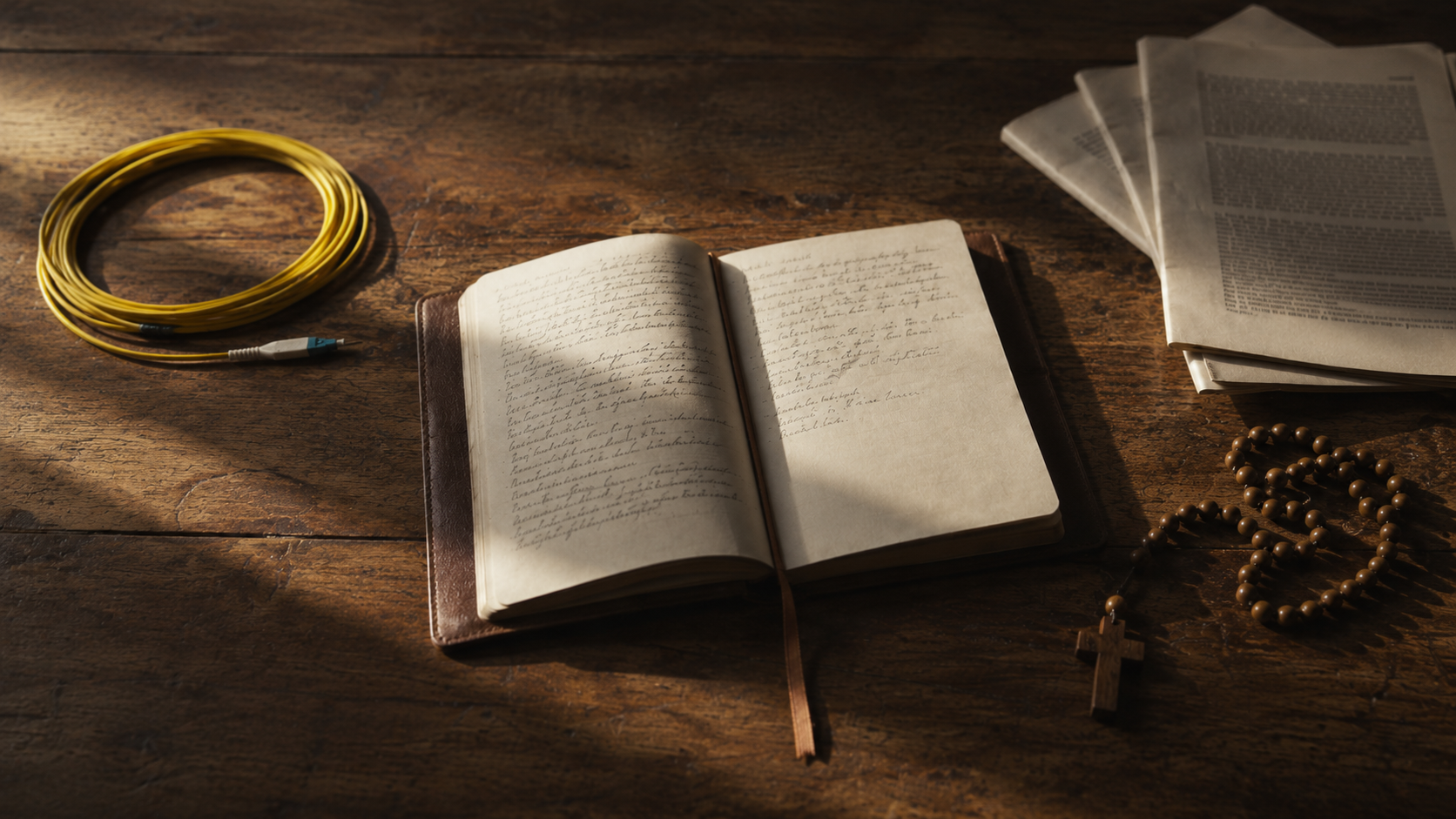
I spent Monday morning reviewing an RFP for a build that will, eventually, run AI workloads. I spent Monday evening reading the first thirty pages of the encyclical that asks for those same workloads to be disarmed.
First off, I want to be upfront about where I am writing from. I am a Catholic. I am also a working professional in enterprise infrastructure. The physical layer the AI conversation depends on but rarely names. I believe AI is a genuinely useful tool. I also believe, with Pope Leo XIV, that it must be safeguarded from the abuse it is being put to in the hands of some of the people who build it, fund it, and deploy it. Those two beliefs are not in tension. The first is the reason the second matters.
What follows is one practitioner's read of Magnifica Humanitas — what the Pope actually said, why the word he chose is the right one, and what a Catholic working in this stack does with it on Tuesday morning.
What Pope Leo XIV Actually Said
On May 25, 2026, Pope Leo XIV presented his first encyclical, an 82-page document titled Magnifica Humanitas ("Magnificent Humanity"), focused on safeguarding the human person in the time of artificial intelligence. He signed it on May 15, exactly 135 years after his namesake, Leo XIII, signed his own transformational document on workers' rights during the Industrial Revolution — Rerum Novarum, the encyclical that anchored Catholic social teaching to the conditions of working people during the first industrial age.
That parallel is deliberate. This is not a pope reacting to a tech trend. This is a pope picking up a hammer his predecessor put down 135 years ago and turning it toward the next industrial revolution.
The thesis is plain. Like nuclear energy before it, AI must serve the common good rather than become an instrument of domination. Today, in too many hands, it is moving in the wrong direction. "Artificial intelligence needs to be disarmed," the Pope said in the Synod Hall, and then immediately acknowledged the weight of the language. He chose the word deliberately, he explained, because the moment needs language capable of attracting attention, awakening consciences, and indicating paths forward for humanity.
Disarmed. Not banned. Not denounced. Disarmed. Stripped of the capacity to be wielded as a weapon against the human person.
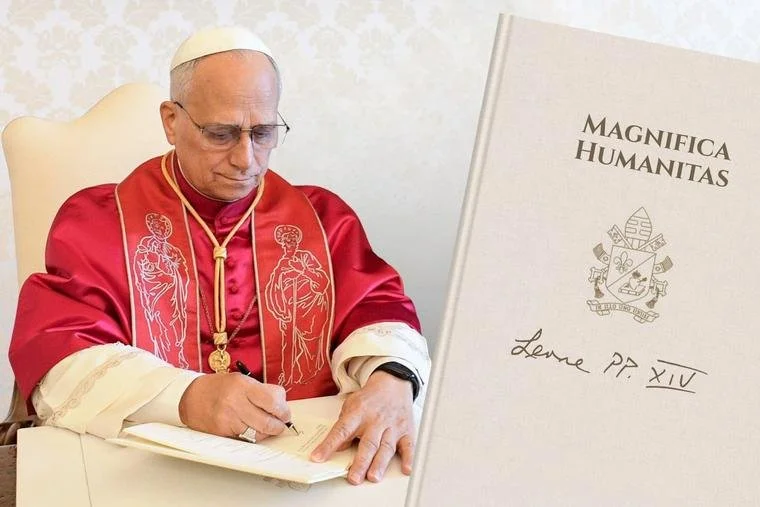
Pope Leo signing his Magnifica Humanitas Encyclical, a solemn moment marking the formal proclamation of its principles.
Why "Disarmed" Is the Right Word
I understand the instinct from inside the industry to soften that language. The technology is a tool. The use case is the problem. The tool itself, by itself, is morally neutral. I have made versions of this argument myself, and there is real truth in it. AI is a tool, and like any powerful tool, the moral weight tracks the hand that wields it.
But the Pope sharpens the point in a way I have come to think is correct. "Technology is never neutral," he writes, because every tool eventually takes on the characteristics of those who design it, finance it, regulate it, and deploy it at scale. That is not a condemnation of the engineer or the architect. It is the opposite. It is the recognition that the people building this, the engineers, the architects, the operators, the funders, the regulators, are the ones whose values get baked into what the tool becomes in the world.
That is not a problem when those values are sound. It is a problem when the dominant pressures shaping the field are speed, scale, geopolitical advantage, and commercial dominance.
A tool is shaped by the hand that holds it. The hand currently holding this one is, in too many cases, the hand of whoever can afford the largest dataset and the densest fiber. That is the abuse the Pope is asking the world to disarm, not the technology itself, but the way it is being wielded.
The Concerns Leo Flagged That I See Up Close
Three of the Pope's concerns are not abstractions for anyone working in this stack. Autonomous weapons systems. Algorithmic gatekeeping of healthcare, employment, and security. And the concentration of AI capability in the hands of whoever can outspend everyone else on capacity. All three live downstream of decisions made at the physical layer.
On autonomous weapons, the Pope is plain. He writes that lethal or otherwise irreversible decisions must not be entrusted to artificial systems. From the infrastructure side, the question is not whether the capability exists. It does. The question is whether the contract for the compute that powers it ever specifies the use case. Usually, it does not. The contract says compute. The use case is downstream. The conscience, somehow, is supposed to live further downstream still.
On algorithmic gatekeeping, the Pope cited "data tainted by prejudice and injustice" blocking ordinary people from healthcare, employment, and security. This is largely a model-layer problem. But the model layer does not exist without the capacity layer underneath it. The decisions about whose workloads get prioritized, whose datasets get the bandwidth, and which deployments get green-lit are not neutral. They are choices.
On concentration, the Pope warned against a race for ever more powerful algorithms and ever larger datasets, a race driven, in his framing, by the desire to secure geopolitical and commercial dominance. Anyone in capacity planning has watched this race in real time over the last thirty-six months. The race is the thing. The reflection, in the current pace, is supposed to come later.
What is striking about the press conference at the Vatican is who was sitting in the room. Christopher Olah, co-founder of Anthropic, one of the leading AI companies in the world, attended the presentation. In his own remarks, Olah pointed to three areas requiring urgent attention: the risk of widespread job losses, the need to ensure the benefits of AI are extended worldwide, and the unresolved question of how to interpret increasingly complex and sometimes opaque system behavior.
These are the words of a builder, not a critic. They sit comfortably alongside the Pope's. That is the conversation Leo is calling for, not industry against the Church, but the people inside the work honestly admitting where the guardrails are missing.
What "Remaining Profoundly Human" Looks Like at the Physical Layer
The Pope's pressing duty, stated plainly in the document, is "to remain profoundly human." For a builder, that is not abstract. It is the discipline of refusing to design, specify, or deploy a system without asking what it will be used for and who it could harm.
The industry has historically allowed the infrastructure layer to plead ignorance. The rack is just a rack. The fiber is just fiber. The data center is just a data center. The moral weight, somehow, always seems to settle on whoever sits closer to the application layer. The Pope names that retreat directly. AI, he reminds the reader, does not undergo experiences, does not possess a body, does not feel joy or pain, and does not mature through relationships. The human conscience is the one thing the machine cannot supply. Outsourcing that conscience to the next layer up, to the application engineer, to the product manager, to the policy team, is the failure he is warning against.
This is the part of the encyclical that should sit closest to anyone who works in this field and goes to Mass on Sunday. The pew on Sunday and the rack on Monday have to be served by the same conscience. The Pope is asking us to stop pretending otherwise.
Where the Working Catholic Goes From Here
I do not read Magnifica Humanitas as an exit notice. I actually have never read one before this. The Pope did not write 82 pages to ask Catholics to step away from this work. He wrote them to ask the Catholics already in it to stop pretending the work is morally neutral, and to start treating it with the proportionate seriousness the moment demands. There is a meaningful difference.
For the practitioner, Catholic or not, sitting with the encyclical on a Tuesday morning, four things are worth doing:
Read Magnifica Humanitas directly, not the coverage of it. The Pope's own words carry weight the summaries cannot. Have questions? Ask your priest, don’t refer to social media for answers.
Map the system on your desk this week to the three concerns Leo flagged: weapons, gatekeeping, concentration. Most systems sit downstream of at least one.
Name the use case in writing, even when the contract does not require it. The infrastructure layer's ignorance of what it is powering is, increasingly, a choice rather than a fact.
Refuse the technical-purity dodge. The rack is not just a rack when the rack is racked for a use case that violates the conscience.
None of these are policy demands. They are the field notes of one Catholic working in this industry, trying to take seriously what the Pope just put on the table. This is not an easy thing to work through, but something that demands real thought and reflection.
The Refiner's Fire and the Server Room
Leo XIII wrote Rerum Novarum into the smoke of the first industrial revolution. Leo XIV has written Magnifica Humanitas into the hum of the next one. The cadence is the same. The Church does not ask the worker to leave the factory. She asks him to bring his soul into it.
The refiner's fire has always been the work of the man who knows what the metal is for. The server room is no exception. AI is a useful tool. It is also a powerful one. Powerful tools, as the Pope reminds us, must be safeguarded from the capacity to be turned against the person, which is to say, the people who build them must keep their conscience in the room.
Sit with one paragraph of the encyclical this week. Take one specific question from it into Monday morning. That is the small, faithful work of remaining profoundly human in a field that is, right now, accelerating faster than its conscience.
Get the working notes.
If you are processing what Leo just put on the table, quietly, in your own way, between the demands of the day, The Private Frequency is a small inbox channel for builders doing the same. No hype, no algorithm. Just the field notes. THE FREQUENCY
Sources
Catholic Register / OSV News. "Pope Leo XIV tells Vatican press conference AI must be 'disarmed' for humanity's sake." https://www.catholicregister.org/item/3963-pope-leo-xiv-tells-vatican-press-conference-ai-must-be-disarmed-for-humanitys-sake
Catholic Review / CNS. "In first encyclical, Pope Leo urges world to 'disarm' AI amid increased reliance." https://catholicreview.org/in-first-encyclical-pope-leo-urges-world-to-disarm-ai-amid-increased-reliance/
National Catholic Reporter. "Pope Leo calls to 'disarm' AI in major document, warns of technologic threats to humanity." https://www.ncronline.org/vatican/vatican-news/pope-leo-calls-disarm-ai-major-document-warns-technologic-threats-humanity
CBS News. "Pope Leo calls for 'disarming' of AI in technology-focused encyclical." https://www.cbsnews.com/news/pope-leo-ai-encyclical-artificial-intelligence/
PBS NewsHour. "Pope Leo warns AI should be 'disarmed' in manifesto on potential dangers." https://www.pbs.org/newshour/show/pope-leo-warns-ai-should-be-disarmed-in-manifesto-on-potential-dangers
Al Jazeera. "Pope says AI must be 'disarmed' to prevent domination, exclusion and death." https://www.aljazeera.com/news/2026/5/25/pope-says-ai-must-be-disarmed-to-prevent-domination-exclusion-and-death
Pope Leo XIV. Magnifica Humanitas: On Safeguarding the Human Person in the Time of Artificial Intelligence. Vatican, May 15, 2026. [VERIFY: confirm Vatican.va URL once full text is published in English]
Pope Leo XIII. Rerum Novarum. Vatican, May 15, 1891. https://www.vatican.va/content/leo-xiii/en/encyclicals/documents/hf_l-xiii_enc_15051891_rerum-novarum.html